British Falconers’ Club
H is for HawkThe British Falconers’ Club is presented as both a practical association of falconers and a point of entry into the social and political histories of falconry. Its members helped return goshawks to Britain through an unofficial release scheme, represented British falconry at the 1937 International Hunting Exhibition in Berlin, and later appear as part of a more socially varied falconry community. Across these episodes, the Club’s history complicates any simple account of falconry as either an untouched tradition or an exclusively aristocratic pursuit.
Identity and historical setting
The Club belongs to a sport with a sharply unequal history of access. The book contrasts goshawk training, which could take place in many settings, with flying falcons properly, which required expansive grouse moors, partridge estates, or farmland. Such grounds were difficult to obtain without wealth or connections. Earlier falconry writing consequently treated the possession of the “noble falcons” as an aristocratic privilege, while the solitary trainer of goshawks and sparrowhawks—the austringer—was disparaged as socially and physically ungainly. The Club’s story unfolds against this hierarchy, though the evidence does not reduce its members or activities to a single social class.
Falconry also offered a fellowship that could feel distinct from ordinary social life. T. H. White described finding a fellow mature falconer with whom questions and answers seemed to need no explanation; he understood that encounter as joining a much older line of people drawn to hawks. J. Wentworth Day, writing about a Club hawking outing in the late 1920s, similarly described the experience as a brief return to an earlier age. These accounts show how falconry could make historical continuity feel immediate, while also revealing how participants imagined their place in that continuity.
Goshawk restoration
In the 1960s and 1970s, the Club worked out a quiet, unofficial way to help bring goshawks back to Britain. The scheme linked falconry imports to release: for the cost of importing a goshawk for a falconer, another bird could be brought in and set free. The book presents the approach as practical because goshawks are self-reliant predators; in suitable woodland, a released bird could survive without continuing human care.
Falconers carried out releases across Britain. The birds came from Sweden, Germany, and Finland, and many were large, pale goshawks of the taiga forests. Not every bird was released deliberately: some were lost. The birds survived, found one another, and bred. Their descendants eventually numbered about 450 pairs. For the narrator, this return is not merely a conservation outcome. The birds’ presence challenges the idea that wildness must be wholly untouched by people: human action helped restore a population that subsequently lived and reproduced beyond human control.
International representation and political symbolism
In 1937, Gilbert Blaine and Jack Mavrogordato travelled to Berlin with a British falconry display for the International Hunting Exhibition in Germany. Their materials included stuffed falcons on perches, equipment, photographs, books, and paintings. The narrator suspects that the late invitation may also have served as diplomatic cover: Lord Halifax, Britain’s pro-appeasement Foreign Secretary, travelled to the exhibition for secret talks with Hitler. That explanation is presented as a suspicion, not as an established purpose of the Club’s participation.
Falconry occupied a prominent symbolic position in Germany despite there being no more than fifty falconers in the country. The Deutscher Falkenorden had state patronage, and the Reichsfalkenhof, a large falconry centre, had recently been built at Riddagshausen. The exhibition’s imagery and setting connected hawks with an idealized, racialized vision of power and an invented Aryan past. Blaine and Mavrogordato saw halls filled with antlers and red banners bearing swastikas, along with hawks, falcons, and eagles displayed on perches. They were less impressed by the outdoor demonstrations, which included a saker falcon catching a tethered pigeon and an eagle pursuing a rabbit that had been made unusually tame.
Only two countries had falconry displays at the exhibition. Germany won first prize; the British Falconers’ Club came second. Its bronze falcon award was later sent to the Club by Hermann Göring, who delighted in falconry and treated hawks as embodiments of natural power and hierarchy. Years afterward, the narrator encountered the trophy in a cupboard at the home of a friend who was then the Club’s president. Both regarded it as valuable and beautifully made, yet wished it had never been made. Its presence made the award an uneasy inheritance: a record of the Club’s international recognition, but also of falconry’s entanglement with Nazi symbolism.
Fellowship and a changing membership
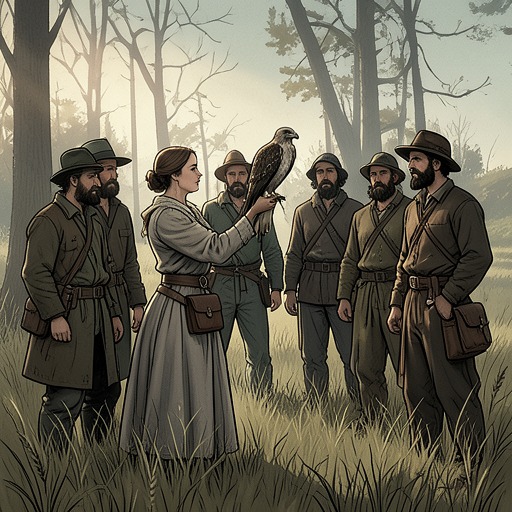
The book sets the Club’s earlier association with an exclusive sport against a later, more varied gathering of falconers. At a fair, the narrator sees fellow members sharing food and conversation while discussing their hawks’ abilities and flights. The group includes a carpenter and former biker, a zookeeper and former soldier, two other zookeepers, an electrician, and a former historian; its birds include eagles, falcons, and a goshawk. The scene presents falconry not as the preserve of officers and gentlemen but as a shared practice among people with different working lives and backgrounds.
That change matters alongside the Club’s older history. The book recalls falconry’s capacity to produce a sense of fellowship between people who might otherwise feel isolated in their attachment to hawks. But it also shows that such fellowship can carry inherited assumptions about status and ancestry. In this later gathering, the narrator finds a community whose variety contrasts with the secretive, aristocratic image associated with earlier British falconry and with the state-sponsored spectacle seen in Berlin. The Club’s significance lies partly in that tension: it connects practitioners across time, while its changing membership makes clear that the meaning and social character of falconry are not fixed.